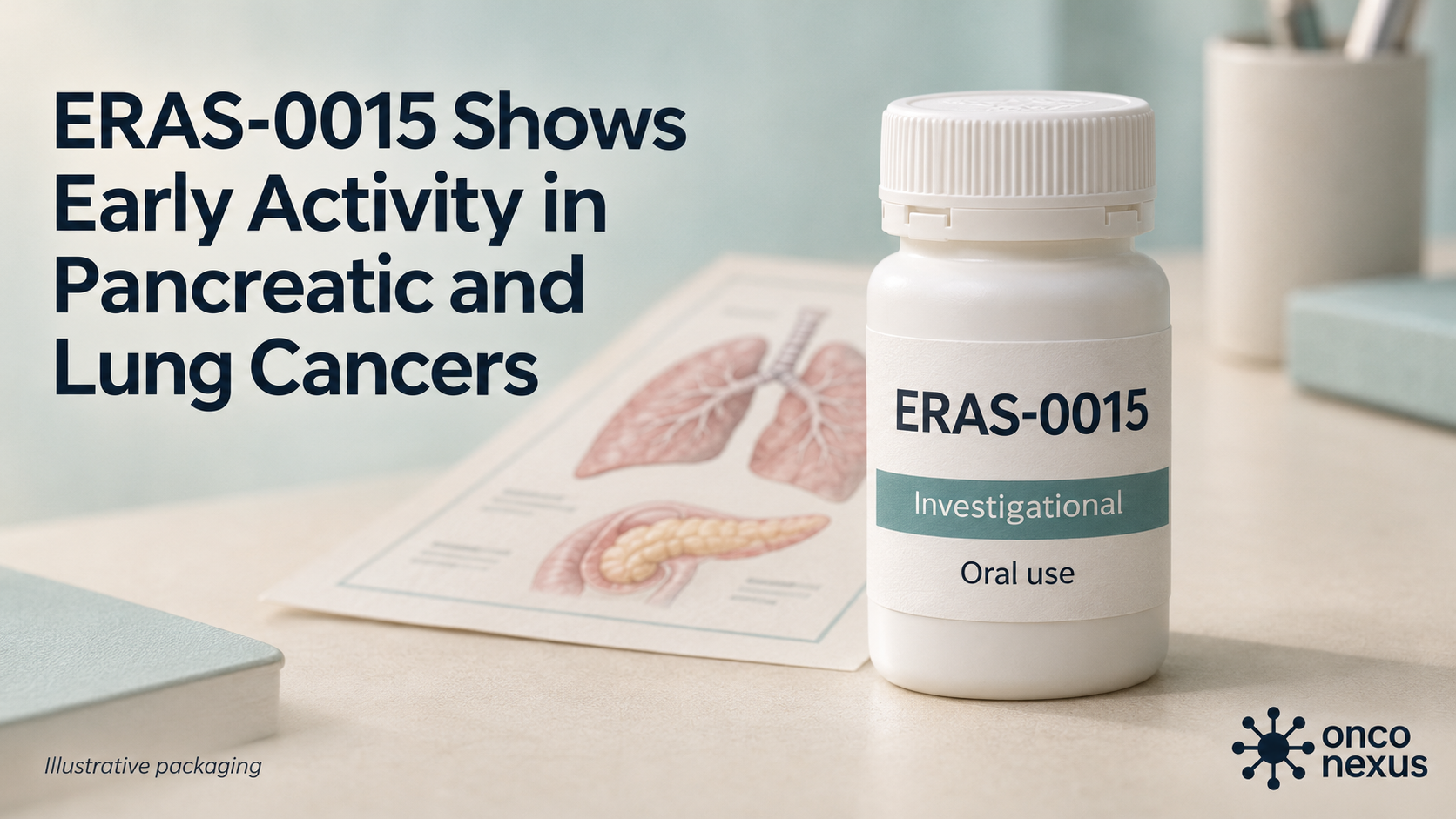
Erasca, Inc. announced updated Phase 1 interim data for ERAS-0015, its pan-RAS molecular glue inhibitor, in patients with RAS-mutant solid tumors, including pancreatic ductal adenocarcinoma (PDAC), non-small cell lung cancer (NSCLC), and biliary tract cancer (BTC). The data were released on November 20, 2026, and cover both monotherapy results from the AURORAS-1 trial and early combination data with several established agents.
At the 32 mg once-daily dose, ERAS-0015 monotherapy achieved a 44% confirmed objective response rate (ORR) in second-line or later KRAS G12X PDAC, a 60% confirmed ORR in post-immunotherapy/platinum KRAS G12X NSCLC, and 75% confirmed ORR in the KRAS G12X BTC first-line or greater setting. These results were generated in a heavily pretreated population — 84% of PDAC patients had received three or more prior lines of therapy — and cross-trial comparisons remain subject to the usual limitations of non-randomized Phase 1 data.
Key finding
ERAS-0015 at 32 mg once daily achieved a 69% confirmed ORR in patients with KRAS G12D or G12V PDAC in the second-line or later setting — mutation subtypes that together account for nearly 70% of pancreatic cancer cases — though these results come from a small, single-arm Phase 1 cohort and have not been confirmed in a randomized trial.
Study Design
| Trial | AURORAS-1 (Phase 1) |
|---|---|
| Population | Adults with advanced RAS-mutant solid tumors, including KRAS G12X PDAC, KRAS G12X NSCLC, and KRAS G12X BTC |
| Treatment | Pan-RAS Molecular Glue ERAS-0015 monotherapy at pharmacologically active doses of 16–32 mg once daily; combination arms with gemcitabine plus nab-paclitaxel, pembrolizumab, and panitumumab also reported |
| Primary endpoint | Safety, Tolerability, Pharmacokinetics, Pharmacodynamics and Preliminary Efficacy |
| Key secondary endpoints | Objective Response Rate, Duration of Response, Time to Response (from study registration) |
The interim analysis presented here covers monotherapy results at pharmacologically active doses in 122 patients, with a subset analysis focused on the 32 mg once-daily dose level. Combination cohorts were reported as early-stage data only, with dose escalation ongoing or planned.
Results and Safety
In 2L+ KRAS G12X PDAC at 32 mg once daily (N=25), the confirmed ORR was 44%, with 84% of patients having received three or more prior lines of therapy and 44% harboring the less drug-sensitive G12R mutation. Among the subset with KRAS G12D or G12V mutations (N=13), the confirmed ORR rose to 69%, including 63% in G12D patients (N=8) and 80% in G12V patients (N=5). All 11 patients who achieved a confirmed response remained on treatment at the time of data cutoff. In 2L/3L KRAS G12X NSCLC following prior immunotherapy and platinum-based chemotherapy, the confirmed ORR was 60% at 32 mg once daily (N=5) and 58% across the 16–32 mg dose range (N=12). Activity was observed across multiple mutation subtypes, with 60% ORR in G12D (N=5) and 50% in G12V (N=4) patients. In a small cohort of 1L+ KRAS G12X biliary tract cancer patients (N=4), the confirmed ORR was 75%. Duration of response and progression-free survival data were not reported in the source material.
At 32 mg once daily (N=54), ERAS-0015 continues to be generally well tolerated. Treatment-related adverse events were mostly low grade, with no dose-limiting toxicities reported. Dose interruptions due to treatment-related adverse events occurred in 13.0% of patients and dose reductions in 16.7% of patients; the rate of treatment discontinuations due to adverse events was not fully detailed in the available source text. The company stated that the frequency and severity of treatment-related adverse events remained consistent with interim data previously disclosed in April and July 2026.
Early combination data with gemcitabine plus nab-paclitaxel, pembrolizumab, and panitumumab showed favorable tolerability, though response rate data for the combination cohorts were not disclosed in detail. Separately, the company reported that ERAS-4001, a potential first-in-class pan-KRAS inhibitor, showed preliminary antitumor activity and encouraging pharmacokinetics in Phase 1 monotherapy, with combination dose escalation alongside ERAS-0015 expected to begin in 2027.
Clinical Context
KRAS mutations drive a substantial proportion of pancreatic and lung cancers, yet broadly active RAS-targeting agents have remained elusive. Mutation-selective inhibitors such as sotorasib and adagrasib address only specific KRAS variants, leaving patients with G12D, G12V, G12R, and other subtypes with limited targeted options. A pan-RAS molecular glue capable of generating responses across multiple mutation subtypes, including G12R, which is considered less sensitive to many emerging inhibitors, could meaningfully expand the treatable population if activity is confirmed in larger trials. Erasca has indicated plans to initiate a potentially registration-enabling trial in 2L+ NSCLC in the first half of 2027, a Phase 3 trial in 1L NSCLC in the second half of 2027 to the first half of 2028, and an accelerated Phase 3 trial in 1L PDAC in the first half of 2027.
The current results, while encouraging, are derived from small, non-randomized Phase 1 cohorts, and the company itself notes the limitations of cross-study comparisons with other pan-RAS or mutant-selective inhibitors. Confirmatory randomized data will be needed to establish whether the response rates observed here translate into meaningful improvements in progression-free or overall survival.
Sources
- GlobeNewswire / Erasca, Inc. “Erasca Reports Broad and Robust Phase 1 Clinical Efficacy and Favorable Safety Data for Pan-RAS Molecular Glue ERAS-0015.” Press release. November 20, 2026. View source