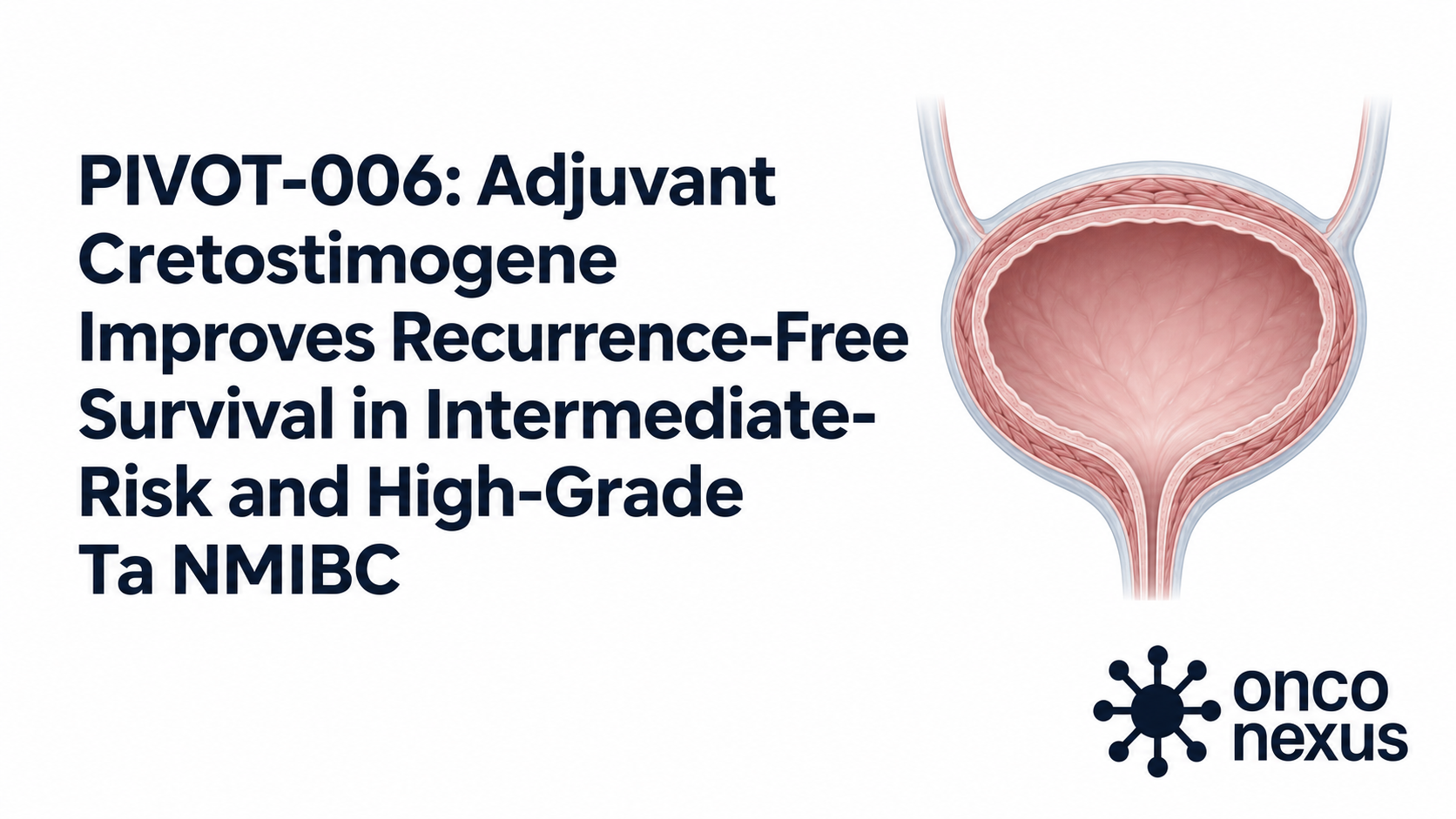
CG Oncology announced positive topline results from PIVOT-006, a Phase 3 registrational trial evaluating adjuvant intravesical cretostimogene grenadenorepvec in patients with intermediate-risk and high-grade Ta non-muscle invasive bladder cancer (NMIBC) following complete tumor resection. The November 16, 2026 announcement marks the first Phase 3 trial to demonstrate a statistically significant recurrence benefit in this population, for which no FDA-approved adjuvant treatment currently exists.
The trial met its primary endpoint, with cretostimogene reducing the risk of recurrence by 68% compared with surveillance alone (hazard ratio 0.32; 95% CI: 0.23, 0.45; p<0.0001) at a median follow-up of 17 months as of October 26, 2026. Detailed data beyond this topline readout, including recurrence-free survival curves, subgroup analyses, and duration-of-response data, were not disclosed in the announcement and are expected to be presented at the Society of Urologic Oncology Annual Meeting on December 2, 2026.
Key finding
In the Phase 3 PIVOT-006 trial, adjuvant cretostimogene grenadenorepvec reduced the risk of recurrence by 68% versus surveillance in intermediate-risk and high-grade Ta NMIBC (HR 0.32; p<0.0001), though these are topline results at a median 17-month follow-up and full data have not yet been published.
Study Design
| Trial | PIVOT-006 (Phase 3 registrational) |
|---|---|
| Population | Adults with intermediate-risk or high-grade Ta ≤3 cm NMIBC following complete tumor resection; enrolled patients had recurrent low-grade Ta <12 months, solitary low-grade Ta >3 cm, low-grade Ta multifocal, solitary high-grade Ta ≤3 cm, or low-grade T1 disease |
| Treatment | Adjuvant intravesical cretostimogene grenadenorepvec vs. surveillance (control) |
| Primary endpoint | Recurrence-free survival (RFS) |
PIVOT-006 enrolled 367 patients across approximately 90 sites in the United States and Canada, making it one of the largest randomized Phase 3 studies conducted in intermediate-risk NMIBC. The control arm reflected real-world clinical practice by using surveillance following complete resection rather than an active comparator, as no approved adjuvant standard of care exists in this setting.
Results and Safety
PIVOT-006 achieved its primary endpoint with a hazard ratio of 0.32 (95% CI: 0.23, 0.45; p<0.0001), corresponding to a 68% reduction in the risk of recurrence for cretostimogene versus surveillance at a median follow-up of 17 months. CG Oncology characterized the improvement as statistically significant and clinically meaningful. The company noted that the recurrence-free survival benefit was observed across both high-grade and low-grade patient subgroups, though subgroup-level data were not provided in the topline release.
The safety profile was consistent with prior cretostimogene studies. There were no Grade 3 or higher treatment-related adverse events (TRAEs) and no treatment-related discontinuations reported. The company described tolerability as compelling, though a full adverse event breakdown — including rates of specific TRAEs — was not disclosed in the topline announcement.
Clinical Context
Approximately 50,000 patients in the United States are estimated to have intermediate-risk or high-grade Ta NMIBC, and no FDA-approved adjuvant therapy currently exists for this population following complete tumor resection. Recurrence in this setting typically requires additional invasive procedures such as repeat transurethral resection, contributing to ongoing disease burden and healthcare utilization. A treatment that significantly reduces recurrence risk in this group could represent a meaningful shift in clinical practice.
CG Oncology plans to submit a Biologics License Application (BLA) for cretostimogene in intermediate-risk and high-grade Ta NMIBC in Q2 2027. Separately, based on FDA feedback, the company intends to broaden its initial BLA in BCG-unresponsive NMIBC — originally focused on carcinoma in situ with or without papillary disease — to also include patients with high-grade papillary-only disease, with that submission now expected by the end of March 2027. Whether the FDA will grant priority review or how long regulatory evaluation will take remains unknown.
Sources
- CG Oncology, Inc. “PIVOT-006 Phase 3 Registrational Trial Demonstrates Unprecedented Improvement in Recurrence-Free Survival (RFS) for Intermediate-Risk and High-Grade Ta Non-Muscle Invasive Bladder Cancer (NMIBC).” Press release. November 16, 2026. View source.