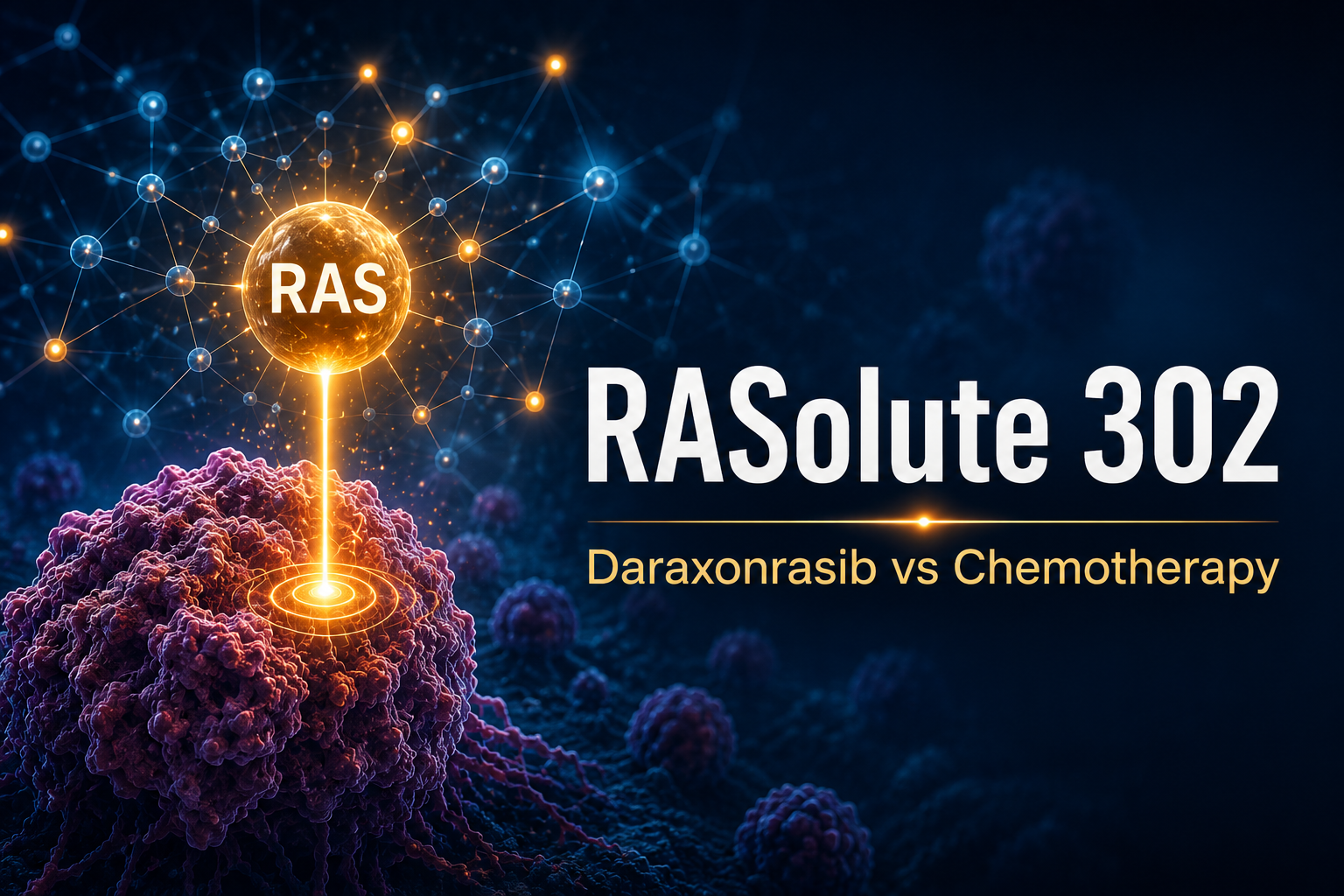
The Phase 3 RASolute 302 trial has demonstrated that daraxonrasib, an oral RAS(ON) multi-selective inhibitor, nearly doubles overall survival compared to standard-of-care chemotherapy in patients with previously treated metastatic pancreatic adenocarcinoma (mPDAC). The study met all primary and key secondary endpoints, showing statistically significant and clinically meaningful improvements in both overall survival and progression-free survival across RAS G12 mutant and overall patient populations.
Clinical Takeaway
Daraxonrasib represents a potential paradigm shift in second-line mPDAC treatment, delivering unprecedented survival benefits with median overall survival of 13.2 months versus 6.6-6.7 months for chemotherapy. The drug demonstrated consistent efficacy regardless of RAS mutation status with lower rates of treatment discontinuations compared to standard chemotherapy.
Drug Profile & Mechanism
- Drug Name: Daraxonrasib
- Class: Oral, RAS(ON) multi-selective, tri-complex inhibitor
- Mechanism: Targets the active, GTP-bound state of both mutant and wild-type RAS proteins
- Dosing: 300 mg orally once daily
- Rationale: Addresses the key driver of PDAC, as oncogenic RAS mutations are identified in greater than 90% of cases, most commonly at codon G12
Target Population
- Primary Population: Patients with second-line metastatic pancreatic adenocarcinoma
- Performance Status: ECOG 0-1
- Mutation Status: Efficacy demonstrated in both RAS G12 mutant and overall populations (regardless of RAS mutation status)
- Unmet Need: Available second-line therapies offer limited benefit with reported median PFS of 3-4 months and median OS of 6-7 months
Study Design
- Trial Name: RASolute 302 (NCT06625320)
- Design: Global, randomized, open-label Phase 3 study
- Randomization: 1:1 to daraxonrasib 300 mg PO QD or investigator’s choice of standard-of-care cytotoxic chemotherapy
- Enrollment: 500 patients (248 daraxonrasib, 252 chemotherapy)
- Data Cutoff: February 10, 2026
- Median Follow-up: 8.5 months
Endpoints
- Dual Primary Endpoints:
- Overall survival (OS) by blinded independent central review (BICR) in RAS G12 mutant population
- Progression-free survival (PFS) by BICR in RAS G12 mutant population
- Key Secondary Endpoints:
- OS and PFS by BICR in overall population
- Objective response rate (ORR) by BICR in RAS G12 and overall populations
Efficacy Outcomes
All primary and key secondary endpoints were met with statistically significant and clinically meaningful improvements observed across all populations:
- Overall Survival – RAS G12 Population:
- Daraxonrasib: 13.2 months (95% CI: 10.0-NE)
- Chemotherapy: 6.6 months (95% CI: 5.4-8.2)
- Hazard ratio: 0.40 (95% CI: 0.30-0.54), p<0.0001
- Overall Survival – Overall Population:
- Daraxonrasib: 13.2 months (95% CI: 10.0-NE)
- Chemotherapy: 6.7 months (95% CI: 5.8-8.0)
- Hazard ratio: 0.40 (95% CI: 0.30-0.53), p<0.0001
- Progression-Free Survival – RAS G12 Population:
- Daraxonrasib: 7.3 months (95% CI: 6.3-8.1)
- Chemotherapy: 3.5 months (95% CI: 2.9-3.8)
- Hazard ratio: 0.45 (95% CI: 0.34-0.59), p<0.0001
- Progression-Free Survival – Overall Population:
- Daraxonrasib: 7.2 months (95% CI: 5.7-7.5)
- Chemotherapy: 3.6 months (95% CI: 2.9-4.2)
- Hazard ratio: 0.49 (95% CI: 0.38-0.64), p<0.0001
- Objective Response Rate:
- RAS G12 population: 33.2% vs 11.8%
- Overall population: 31.6% vs 11.2%
Safety
Daraxonrasib demonstrated a manageable safety profile with fewer severe adverse events and treatment discontinuations compared to chemotherapy:
- Grade ≥3 Treatment-Related Adverse Events:
- Daraxonrasib: 43.6% of patients
- Chemotherapy: 57.5% of patients
- Most Common Grade ≥3 Treatment-Related Adverse Events:
- Daraxonrasib: Rash (13.7%), stomatitis (12.0%)
- Chemotherapy: Neutrophil decrease (18.2%), anemia (16.4%)
- Treatment-Related Serious Adverse Events:
- Daraxonrasib: 10.8%
- Chemotherapy: 18.7%
- Treatment Discontinuation Due to Adverse Events:
- Daraxonrasib: 1.2%
- Chemotherapy: 11.2%
- Dose Intensity: Median/mean daraxonrasib dose intensity was 93.1%/84.7%
- Safety Profile: No new safety signals identified
Key Clinical Implications
✔ Daraxonrasib nearly doubles overall survival compared to standard chemotherapy in second-line mPDAC
✔ Efficacy benefits are consistent regardless of RAS mutation status, expanding potential treatment population
✔ Superior safety profile with significantly lower rates of treatment discontinuation (1.2% vs 11.2%)
✔ Represents a major advance in targeting the RAS pathway in pancreatic cancer
✔ Oral administration offers convenience advantage over intravenous chemotherapy regimens
Bottom Line
RASolute 302 represents a landmark achievement in pancreatic cancer treatment, with daraxonrasib delivering unprecedented improvements in overall survival, progression-free survival, and response rates across patient populations. The study results support daraxonrasib as the new standard of care for second-line mPDAC, offering both superior efficacy and a more favorable safety profile compared to conventional chemotherapy. This breakthrough validates the therapeutic potential of broad RAS(ON) inhibition in pancreatic cancer and may fundamentally change the treatment paradigm for patients with metastatic pancreatic adenocarcinoma.
References:
- O’Reilly EM, Wainberg ZA, Wolpin BM, et al. Daraxonrasib or chemotherapy in previously treated metastatic pancreatic cancer. N Engl J Med. 2026. doi:10.1056/NEJMoa2605555.
- Revolution Medicines. Daraxonrasib demonstrates unprecedented overall survival benefit in pivotal phase 3 RASolute 302 clinical trial in patients with metastatic pancreatic cancer. News release. April 13, 2026. Accessed June 12, 2026. https://ir.revmed.com/news-releases/news-release-details/daraxonrasib-demonstrates-unprecedented-overall-survival-benefit