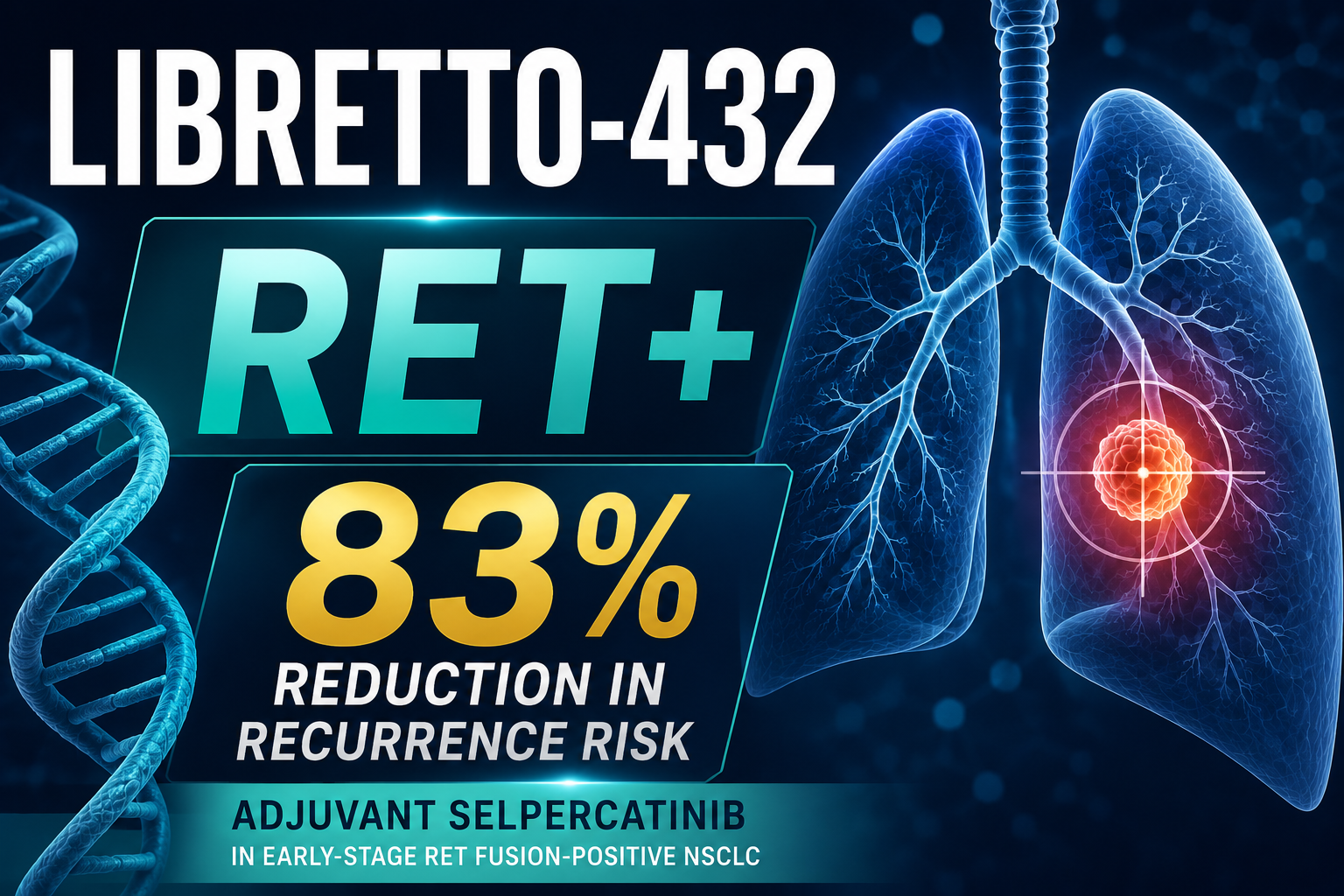
The phase III LIBRETTO-432 trial demonstrated that adjuvant treatment with the selective RET inhibitor selpercatinib significantly reduced the risk of disease recurrence, progression, or death among patients with resected stage IB to IIIA RET fusion–positive non–small cell lung cancer (NSCLC). Results presented at the 2026 ASCO Annual Meeting showed an approximately 83% reduction in the risk of recurrence or death compared with placebo, addressing a critical unmet need in early-stage disease management.
Clinical Takeaway
RET fusions occur in approximately 1% to 2% of patients with NSCLC, and while selpercatinib is already approved for advanced RET-positive NSCLC, no targeted adjuvant therapy has previously been available for patients with early-stage disease. Despite receiving surgery or radiation followed by adjuvant chemotherapy or immunotherapy, up to two-thirds of patients with early-stage NSCLC experience disease recurrence and may ultimately die from metastatic disease.
Drug Profile & Mechanism
Selpercatinib is a highly selective RET kinase inhibitor that targets oncogenic RET alterations, including RET fusions commonly found in NSCLC. The drug demonstrates potent activity against RET-altered tumors while maintaining selectivity to minimize off-target effects.
Target Population
- Patients with resected stage IB to IIIA RET fusion–positive NSCLC
- Completed curative-intent surgery or radiotherapy, with or without adjuvant chemotherapy
- Primary analysis focused on stage II to IIIA disease subgroup at higher risk for recurrence
Study Design
- Design: Global, randomized, placebo-controlled phase III trial
- Enrollment: 151 patients from 22 countries
- Randomization: Selpercatinib (n = 75) vs placebo (n = 76)
- Treatment duration: Up to 3 years of selpercatinib or placebo administered twice daily
- Primary analysis population: 109 patients with stage II to IIIA disease
Endpoints
- Primary endpoint: Investigator-assessed event-free survival (EFS) in the stage II-IIIA population
- Secondary endpoints: Event-free survival by blinded independent central review (BICR), event-free survival in the overall study population, safety, and overall survival
Efficacy Outcomes
- Follow-up: Approximately 2 years in each treatment arm
- Primary Analysis (Stage II-IIIA):
- Median EFS: Not reached (selpercatinib) vs 31.8 months (placebo)
- 2-year EFS rate: 91.5% (selpercatinib) vs 61.1% (placebo)
- Overall Population (All 151 patients):
- Hazard ratio: 0.165 (95% CI: 0.056–0.485, P = .0002)
- Risk reduction: Approximately 83% reduction in recurrence or death
- Median EFS: Not reached in either treatment arm
Safety
- Most common adverse events: Elevations in alanine aminotransferase (62.7%) and aspartate aminotransferase (60.0%)
- Frequently reported adverse effects:
- Dry mouth (40.0%)
- Diarrhea (38.7%)
- Hypertension (30.7%)
- Severity: Grade ≥3 adverse events occurred in 66.7% of patients receiving selpercatinib and were generally manageable with dose modifications
- Deaths during study: Three deaths from lung cancer, all in the placebo arm
Key Clinical Implications
✔ First targeted adjuvant therapy for early-stage RET fusion-positive NSCLC, addressing a critical unmet medical need
✔ Dramatic 83% reduction in recurrence risk provides compelling evidence for adjuvant selpercatinib in appropriate patients
✔ Manageable safety profile consistent with known selpercatinib toxicities and generally manageable with dose modifications
✔ Results support routine RET fusion testing in early-stage NSCLC to identify patients who may benefit from targeted adjuvant therapy
Bottom Line
The LIBRETTO-432 trial represents a landmark achievement in early-stage NSCLC treatment, demonstrating that adjuvant selpercatinib significantly improves event-free survival in patients with RET fusion-positive disease. With an 83% reduction in recurrence risk and a manageable safety profile, these results support adjuvant selpercatinib as a potential new standard of care for patients with RET fusion-positive early-stage NSCLC. The trial continues with longer follow-up planned to assess overall survival and outcomes in specific patient subgroups, including those with stage IB disease.
Sources:
- Goldman JW, Yang X, Hochmair M, et al. Event-free survival with adjuvant selpercatinib in stage IB-IIIA RET fusion-positive NSCLC: primary results of the phase 3 LIBRETTO-432 trial. Presented at: 2026 ASCO Annual Meeting; May 31, 2026. Abstract LBA3.